
A compliance matrix that builds itself – so you never miss a requirement
A requirement is easy to miss when the buyer spreads instructions across specifications, contract documents and response forms. TedBid brings those requirements together with their sources. You can check what the tender asks for without rebuilding the overview by hand.
For bid managers and writers at IT consultancies, advisers and suppliers, a compliance matrix connects reading with action. Use it to assess the opportunity, guide the response and revisit unanswered requirements. Save time on every bid while keeping the buyer’s own wording within reach.
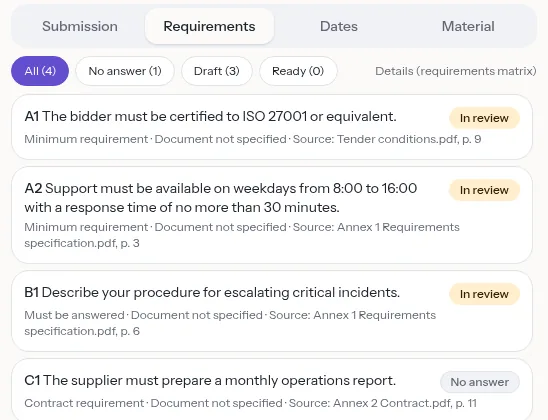
A compliance matrix built from your tender documents
Upload the material as PDF, Word, spreadsheets, text files or ZIP. TedBid finds requirements and records the source file and page. You can return to the passage when wording needs interpretation or a colleague asks where an instruction comes from.
This requirements matrix follows the material you provide. It does not assume fixed document names or a standard set of annexes. Fields absent from the material are shown as not stated.
Separate different kinds of requirements
Not every instruction needs the same response. TedBid identifies minimum requirements, formal requirements, contract requirements and evaluation requirements, so you ask the right questions before drafting begins.
- Check minimum requirements when deciding whether to bid.
- Read formal requirements alongside the submission instructions.
- Review contract requirements before making commitments.
- Use evaluation requirements to focus your written answers.
Keep the strictest consequence when wording repeats
The same requirement may appear in more than one place. TedBid merges repeated requirements and keeps the strictest consequence. Your overview does not treat repeated wording as unrelated tasks or soften its significance.
Use the source references to check the surrounding context, and read important conditions in the original material.
Make the go/no-go decision before writing
See minimum requirements, deadlines and risks before your team invests in answers. TedBid supports go/no-go assessment against your company profile, so you can see whether the opportunity fits what you can deliver.
Start with eligibility and commitments, then consider the writing effort. Do not let a polished draft distract you from a condition you cannot meet.
Follow requirements through to the final check
In the tender chat, ask which minimum requirements have no answer yet. In drafts, missing facts are marked [MANGLER] (missing) and claims without a source are marked [TJEK] (check).
Before submission, the pre-submission check covers markers, file formats, page limits, reservations and signatures. An answer can read well and still leave part of the buyer’s request unanswered – the matrix shows it.
Who uses the compliance matrix
The bid manager uses the matrix to split the work and follow progress. Subject experts see exactly which requirements they own and where each one comes from. The sales lead sees the minimum requirements and deadlines that decide whether the bid is worth the effort.
Everyone works from the same list, so nobody keeps a private spreadsheet that drifts away from the tender material. When the deadline approaches, the status shows how many requirements still have no answer.
Frequently asked questions
Does a compliance matrix replace reading the tender?
No. It gives you a structured overview with file-and-page sources. Use those references to verify important instructions in context.
Can I check requirements through Claude or ChatGPT?
Yes. TedBid’s MCP server lets you read requirements, deadlines and documents and edit draft answers. You sign in and give consent. Nothing is approved or submitted automatically.
What languages can TedBid read?
TedBid reads tender material in Danish and English. The website is in both languages; the app interface is in Danish today.
Is our tender content kept within our organisation?
Yes. Data is separated per organisation, enforced in the database. You own your content, and it is not used to train AI models. Database and files are stored in the EU (Ireland).
Can I start with one tender?
Yes. The Free plan includes one active case with no card required.
Try it on your next tender
Upload the material and see requirements, deadlines and the submission list with sources. Free plan, no card required.